

APPLICATION OF HEMOFILTERCYTOLOGICAL TESTS FOR ASSIGNING ADJUVANT POLYCHEMOTHERAPHY TO CANCER PATIENTS AND EVALUATING ITS EFFICACY
Main Article Content
Abstract
Hemofiltercytological venous blood tests for patients radically operated on for colon cancer reveals circulating tumor cells (CTCs) in the early postoperative period. Their results serve as an indication for assigning adjuvant polychemotherapy to post-operative patients. The repeated hemofiltrocytological test on the intensity of CTCs damages and decrease in their number makes it possible to assess the quality and completeness of adjuvant polychemotherapy.
Keywords
Author Biographies
Георгий Цыренович Дамбаев,
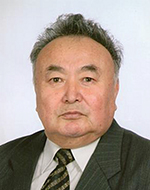
Georgy Ts. Dambaev
MD, PhD, professor, Corresponding Member of the Russian Academy of Sciences, Honored Researcher of Russian Federation
Head of the Hospital Surgery Department with a course of cardiovascular surgery
Анатолий Агванович Чимитов,
candidate of medical sciences, assistant, department of human anatomy and physiologyАлександр Федорович Лазарев,
doctor of medical sciences, professor, head of the department of oncologyЛувсанням Лхагва,
doctor of medical sciences, professor, academician, vice-presidentАлександр Сергеевич Степанов,
oncologistArticle Details
Information about financing and conflict of interests
The authors declare that they have no apparent or potential conflicts of interest related to the publication of this article.
 This work is licensed under a Creative Commons Attribution 4.0 License.
How to Cite
References
Prophets VV, Vlasov OA, Tupitsyn NN. The current state of the problem of treatment and prognosis of colorectal cancer. Oncology issues. 2014; 60: 28-33. Russian (Пророков В.В., Власов О.А., Тупицын Н.Н. Современное состояние проблемы лечения и прогноза колоректального рака //Вопросы онкологии. 2014. Т. 60. С. 28-33.)
Garin AM, Bazin IS. Reference guide to drug therapy of solid tumors. M.: MAX Press, 2010. 368 p. Russian (Гарин А.М., Базин И.С. Справочное руководство по лекарственной терапии солидных опухолей. М.: МАКС Пресс. 2010. 368 с.)
Bzhadug ОВ, Tjulandin SA, Grivtsova LYu, et al. The prognostic value of circulating tumor cells in blood of patients with advanced breast cancer. Haematopoesis Immunology. 2007; 4: 73-101
Cristofanilli M, Budd GT, Ellis MJ, et al. Circulating tumor cells, disease progression, and survival in metastatic breast cancer. N Eng. J Med. 2004; 351(8): 781-791
Cohen SJ, Punt CJ, Lannotti N, et al. Relationship of circulating tumor cells to tumor response, progression-free survival, and overall survival in patients with metastatic colorectal cancer. J. Clin. Oncol. 2008; 26(19): 3213-3221
De Bono JS, Tolcher AW, Rowinsky EK. Farnesyltransferase inhibitors and their potential in the treatment of breast carcinoma. Semin Oncol. 2003; 30(Suppl. 16): 79-92